Your first personal training session is not a fitness test — and a good coach will not try to make you vomit on day one. It is an assessment, a conversation, and a moderate intro workout so you leave with a plan, not just sore legs. Here is exactly what happens in session one at a private Austin gym, what to wear, what to say about injuries, and how to know whether you picked the right coach before you buy a package.
Who This Guide Is For
You booked session one — or you are about to — and you want to know what actually happens so you do not walk in blind. This guide is for Austin clients heading to a commercial gym, a boutique studio, or a private facility like Tiger ATX on Bee Caves.
- Complete beginners who have never worked with a coach
- Experienced lifters switching to a new trainer or private gym
- People returning after injury, surgery, or years away from training
- Anyone nervous about looking foolish or getting pushed too hard
- Clients who want to evaluate a coach before committing to a package
Before Your First Personal Training Session
Preparation reduces anxiety and sets the session up for honest conversation. You do not need a perfect fitness baseline — that is why you hired a coach.
Pre-session checklist
- ✓Complete any intake forms the coach sent — health history, medications, injuries
- ✓Eat a normal balanced meal 1–2 hours before (avoid training completely fasted or stuffed)
- ✓Bring water and a small towel
- ✓Wear comfortable clothes you can squat and hinge in — athletic shoes with flat or moderate sole
- ✓Arrive 10 minutes early to find parking and use the restroom
- ✓Write down your top one to three goals in plain language
- ✓List questions: pricing, frequency, cancellation, nutrition inclusion
- ✓Skip the "pre-workout" you have never used before — session one is not the day to experiment
If you have not chosen a coach yet, invest time in how to choose a personal trainer in Austin and understand what sessions cost before booking.
The first session goes better when you already trust the environment — especially if gym intimidation has stopped you before.
What Happens During Session One — Step by Step
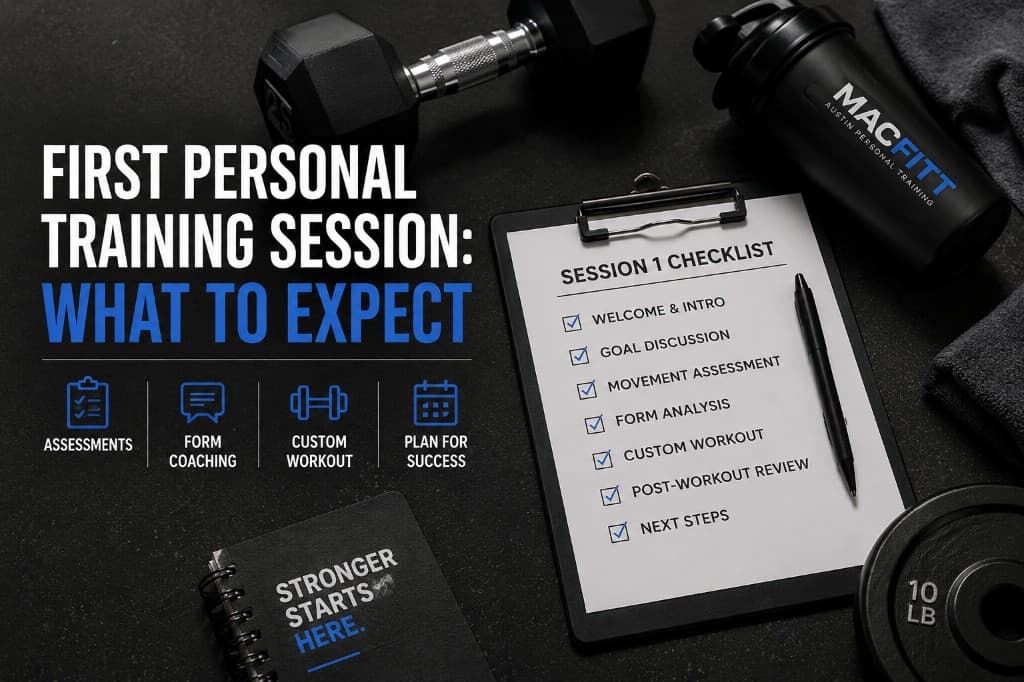
- Welcome and facility tour (5–10 minutes) — especially at a private gym where access and equipment are new
- Goal conversation — what you want, what failed before, schedule and constraints
- Health history — injuries, surgeries, medications, doctor clearance if needed
- Movement assessment — bodyweight squat, hinge, lunge, push, pull; coach notes form and mobility
- Introductory workout — 2–4 exercises with light to moderate load, teaching tempo and breathing
- Wrap-up — recap findings, propose frequency, explain next session focus, answer questions
At MacFitt and Tiger ATX, session one also covers how nutrition guidance fits your plan — because Austin clients who train hard and eat randomly stall fast. That conversation is collaborative, not a lecture.
The Movement Assessment Explained
Movement screening is not grading you — it is mapping your starting point. Coaches use bodyweight patterns and sometimes overhead squat or single-leg balance tests to spot mobility restrictions, stability gaps, and asymmetries that affect loading.
First session myths
If you are returning after years off, tell your coach upfront. The assessment adjusts — and so does intensity. Our getting back in shape guide covers what that restart timeline looks like beyond session one.
The Introductory Workout: What to Expect
The training portion of session one is instructional. Expect a handful of compound patterns — goblet squat or leg press, dumbbell hinge or RDL, push and pull movements — performed at controlled tempo with weight you could repeat for several more reps.
The coach cues breathing, bracing, and range of motion. You are learning, not proving.
- Expect 4–8 sets total across 2–4 exercises — not a 30-set marathon
- Rest periods are longer than group classes — learning requires recovery between attempts
- Your coach demonstrates, then watches you — expect hands-on form cues if you consent
- Cardio finisher optional — not mandatory on day one
- You should feel worked, not destroyed
One-on-one training in a private gym means the intro workout uses equipment matched to your level immediately — no improvising because the squat rack is occupied during the 6 a.m. rush at a commercial gym.
What to Wear and Bring
| Factor | Works well | Skip for session one |
|---|---|---|
| Tops | T-shirt, tank, breathable athletic top | Restrictive dress shirts or jeans |
| Bottoms | Shorts or leggings with full range of motion | Denim, cargo shorts that bind at hip |
| Shoes | Flat-soled trainers or running shoes you train in | Brand-new shoes, sandals, boots |
| Accessories | Water bottle, small sweat towel, hair tie if needed | Heavy lifting belt, wrist wraps you have never used |
| Extras | Completed intake form, list of questions | Full gym bag of supplements and gadgets |
Common First-Session Mistakes
- Hiding an old injury because you do not want to seem "high maintenance"
- Showing up fasted and lightheaded, then blaming the workout for feeling awful
- Expecting max-effort testing instead of movement assessment
- Saying yes to a 20-session package in the parking lot before evaluating session quality
- Comparing yourself to other people on the gym floor instead of your own starting point
- Skipping questions about pricing, cancellation, and what is included in the rate
- Not telling the coach you are nervous — so they cannot adjust pace or explain what is coming
After Session One: Next Steps
A good first session ends with a plan — not a hard sell. You should know recommended frequency (often two sessions weekly initially), what the first training block focuses on, and whether homework (steps, protein, mobility) applies before session two.
Evaluate session one before buying a package
- ✓Did the coach listen more than they lectured?
- ✓Were injuries and limitations taken seriously?
- ✓Was the workout scaled appropriately to your level?
- ✓Did you understand the why behind exercise selection?
- ✓Was pricing and package structure explained clearly?
- ✓Do you feel confident returning — not intimidated?
- ✓Was nutrition or recovery addressed if relevant to your goals?
If something felt off — rushed assessment, generic workout, pressure to buy twenty sessions — trust that instinct. Session one is a two-way interview. See Austin personal training options and book a second opinion if needed.
First Sessions for Special Situations
Not every first session looks identical. Coaches adapt based on who walks in.
| Client type | Session one emphasis |
|---|---|
| Complete beginner | More teaching, lighter load, simpler exercise selection |
| Returning after injury | Medical clearance, pain-free range, conservative loading |
| Experienced lifter, new coach | Performance history, quicker path to working sets |
| Fat loss focused | Nutrition conversation weighted heavily in wrap-up |
| Older adult | Balance, fall prevention, joint-friendly progressions |
Wherever you start, session one sets the tone. Contact MacFitt to schedule yours at Tiger ATX — we will meet you at your level, not someone else's Instagram highlight reel.
Bottom Line
Your first personal training session should leave you clearer, not crushed. Expect assessment, honest conversation about goals and injuries, a moderate intro workout, and a proposed plan for frequency and focus.
Frequently Asked Questions
Typically 45–60 minutes including assessment and workout. Some coaches offer 75-minute intros. Confirm length when booking — a "session" is not always sixty minutes.
Mild soreness one to two days later is common, especially if you are new or returning after time off. Incapacitating soreness suggests the coach overcooked intensity. You should feel able to return for session two within a few days.
If you have cardiovascular disease, uncontrolled hypertension, recent surgery, or other significant medical conditions, yes — get physician clearance. Inform your coach of all medications and injuries on the intake form regardless.
Helpful but not required. Share what worked, what injured you, and what you disliked. Your new coach will design fresh programming based on assessment — not recycle your old spreadsheet unless it still fits.
Ask the coach first. Private gyms often restrict guests for insurance and focus reasons. Some coaches allow a partner for semi-private after individual assessments.
Most Austin trainers require 24-hour notice. Ask about cancellation policy before booking — especially if you paid upfront. Rescheduling early is normal; no-show without notice may forfeit the session fee.
Consultations may be free; first full sessions often are not. Free sessions are marketing tools — valuable, but paid assessments filter serious clients and compensate the coach's time. Either can work if the coach delivers real assessment value.
Tell your coach. Nerves are normal — especially in commercial gyms. Private gym training reduces audience anxiety. Session one is designed for beginners; coaches expect questions and hesitation.
A normal balanced meal one to two hours before works for most people — protein, carbs, moderate fat. Avoid training completely fasted or immediately after a heavy meal. Bring water; skip new supplements you have never tested.
No health history questions, max-effort testing on day one, generic workout with no explanation, pressure to buy a large package immediately, or dismissive responses when you mention pain. A good coach scales, listens, and explains the plan before asking for a long commitment.