You know you need help — but should that help stand next to you in a gym, or review your squat video from your phone at 6 a.m.? In Austin, in-person training runs $85–$200+ per session; full-service online coaching starts around $300+/month. Neither is universally better. The right choice depends on whether you need someone to teach you how to move, or someone to program and hold you accountable once you already know how. Here is how to decide — including the hybrid path most of my clients eventually use.
Who This Guide Is For
You are deciding between hiring an Austin personal trainer and signing up for online coaching — or wondering if you need both. This guide is for anyone stuck in analysis paralysis comparing formats instead of evaluating coach quality.
- Beginners who have never learned barbell or dumbbell form
- Experienced lifters who need periodization but not hands-on teaching
- Austin professionals with unpredictable travel schedules
- Clients returning after injury or years away from training
- People who have ghosted online programs or unused gym memberships before
The Core Differences Between In-Person and Online Coaching
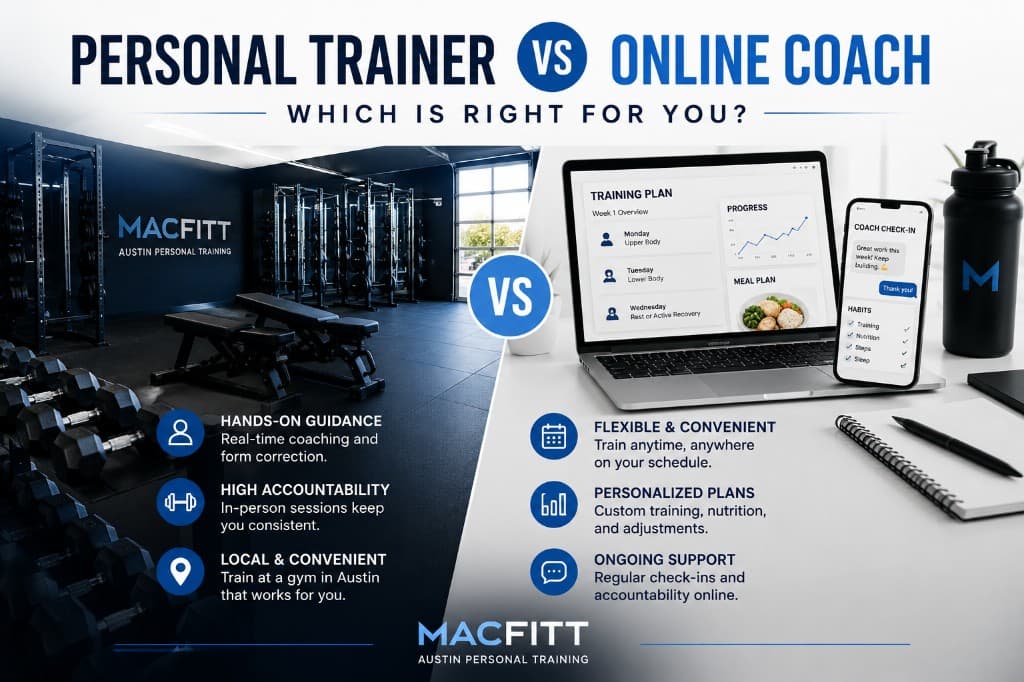
A personal trainer meets you at a gym — often a private facility in Austin or a commercial location — and coaches you through each rep in real time. They adjust weight, fix your setup, and keep you on task for the full session.
An online coach delivers programming through an app or spreadsheet, reviews video submissions or written check-ins, and communicates via text, email, or scheduled calls. You train wherever you have equipment — home gym, commercial gym, hotel fitness center — on your own schedule.
| Factor | In-person personal trainer | Online coach |
|---|---|---|
| Form feedback | Immediate, hands-on correction every set | Video review, often delayed hours or days |
| Scheduling | Fixed appointment times | Train anytime within program structure |
| Accountability | Showing up is built in — appointment is booked | Requires self-discipline to train and report |
| Cost | Higher per-hour rate ($85–$200+ in Austin) | $300+/month (tiered full-service programs) |
| Equipment | Trainer's gym or agreed location | Your gym, home setup, or travel hotel |
| Best for | Beginners, injury returners, low accountability | Experienced lifters, travelers, self-starters |
When an In-Person Personal Trainer Is the Better Choice
Choose in-person training if you are new to strength training, returning after a long break, recovering from injury, or have tried and failed with self-guided programs.
Real-time coaching catches compensations — a hip shift during a squat, a rounded back on a deadlift — before they become ingrained patterns or injuries. The appointment itself creates accountability: you are far less likely to skip a 7 AM session when someone is waiting for you at Tiger ATX Training than when a workout notification pops up on your phone.
Signs you need in-person coaching
- ✓You have never learned proper barbell or dumbbell form
- ✓You are returning after injury, surgery, or years without training
- ✓You have quit gyms before because you felt intimidated or lost
- ✓You struggle to push yourself without someone present
- ✓You need hands-on spotting for heavier lifts
- ✓You want nutrition and training integrated in one relationship
- ✓You value a private, distraction-free training environment
When an Online Coach Makes More Sense
Online coaching works well for experienced lifters who need structured programming, travelers who cannot commit to fixed Austin appointments, and clients who still want expert guidance without twice-weekly drives down Bee Caves.
If you already know how to execute a Romanian deadlift and a bench press, the value shifts from teaching to programming progression, deload timing, and keeping you accountable when life gets chaotic. Built For Life online training and similar programs deliver workouts, nutrition frameworks, and check-in cadence without requiring you to drive to a gym at a specific hour.
- You travel frequently for work and need portable programming.
- You have a solid home gym and prefer training privately.
- You are an experienced lifter who needs periodization, not basics.
- Your schedule changes weekly and fixed appointments do not work.
- You want coaching support at a lower monthly cost than three in-person sessions.
- You live outside Austin but want access to a coach you trust.
Accountability: Where Most People Underestimate the Difference
Accountability is the hidden variable in the personal trainer vs online coach decision. External accountability — a person expecting you — dramatically increases adherence for most people.
In-person training embeds accountability structurally: you book, you show up, you pay for the hour whether you use it well or not. Online coaching relies on softer accountability: messages, app notifications, weekly photo check-ins. That works brilliantly for disciplined clients and fails silently for others who stop responding without formally canceling.
| Mechanism | In-person trainer | Online coach |
|---|---|---|
| Scheduled appointments | Fixed times, cancellation policies | Flexible; easier to defer |
| Financial commitment | Per-session or monthly package | Monthly subscription, often lower total |
| Social pressure | Face-to-face relationship | Digital relationship, easier to ghost |
| Progress tracking | Logged in session, visible on gym floor | Self-reported, requires honesty |
| Form oversight | Continuous during session | Periodic video review |
Be honest with yourself. If you have paid for gym memberships you never used, online coaching alone may repeat that pattern. If you are the person who never misses a calendar invite, online may be perfect.
Read how to choose a personal trainer in Austin for questions to ask any coach — in person or remote.
The Hybrid Approach Many Austin Clients Use
You do not have to pick one format forever. A common path: start with eight to twelve weeks of in-person training to learn movement patterns and build habits, then transition to online programming with monthly in-person check-ins.
Or train in person two days per week and follow an online program for a third session on your own. Hybrid models capture real-time coaching where it matters most — compound lifts, technique resets — while offering flexibility and lower cost for the sessions you can execute independently.
| Day | Format | Focus |
|---|---|---|
| Tuesday | In-person at private gym | Squat, hinge, coach-led form work |
| Thursday | In-person at private gym | Push, pull, progressive overload |
| Saturday | Online-programmed solo session | Accessories, conditioning, homework |
| Weekly | Messaging check-in | Nutrition, sleep, step count adjustments |
Hybrid coaching myths
Common Mistakes When Choosing Format
- Choosing online to save money when you have never learned basic lifting form
- Assuming in-person is always worth three sessions weekly when one plus online homework would suffice
- Treating a $30 workout app as equivalent to a $300+/month coached program
- Picking format before defining your goal — fat loss, strength, return from injury
- Ignoring your track record with unused gym memberships and ghosted check-ins
- Staying in analysis paralysis for months instead of committing to an eight-week trial
How to Make the Right Decision for Your Goals
Start with your goal and your honest self-assessment. Fat loss with no lifting experience? In-person. Experienced lifter prepping for a half marathon who needs strength maintenance? Online. Coming back after years off? In-person first — see how to get back in shape.
Compare personal training costs in Austin against online program fees, but weigh value: a cheaper program you abandon in three weeks is not a bargain.
- Define your primary goal: fat loss, strength, return from injury, general fitness.
- Assess your movement experience honestly — beginner, intermediate, or advanced.
- Evaluate your track record with self-directed fitness programs.
- Consider schedule constraints: fixed appointments vs flexible training windows.
- Set a realistic monthly budget including nutrition support if needed.
- Interview at least one in-person trainer and one online coach before deciding.
- Start with a trial period — four to eight weeks — before long-term commitment.
Jack McNamara offers in-person personal training at a private gym in Austin and remote coaching through Built For Life online training. Book a consultation to discuss which format fits your goals — or whether a hybrid makes sense. No pressure to pick the more expensive option; the right fit is the one you will actually follow for six months.
Bottom Line
In-person training wins on form, safety, and accountability. Online coaching wins on flexibility and schedule fit. Hybrid splits the difference for clients who need both teaching and portability.
Frequently Asked Questions
Often yes on monthly total — full-service online coaching starts around $300+/month, while two in-person sessions weekly at $85–$200+ each adds up faster. Cheap workout apps are not equivalent to coached programs. Cost per result matters more than cost per month. See Built For Life online training for MacFitt program options.
Online coaches review video and provide cues, but they cannot physically spot you or correct mid-rep. For heavy compound lifts, beginners, and injury returners, in-person coaching is safer. Experienced lifters with solid form can train safely online with periodic video review.
Beginners benefit most from in-person coaching for at least the first two to three months. Learning to brace, hinge, and squat without real-time feedback often ingrains bad habits. After fundamentals are solid, transitioning online is reasonable. Read what to expect at your first session.
Varies by program. Some offer daily messaging; others do weekly or biweekly video calls. Ask before signing up. More frequent check-ins usually mean higher accountability and often a higher fee.
Yes. Many clients start in person and move online as they gain competence, or add in-person sessions when they plateau or want hands-on coaching for new movements. Discuss transition options with your coach.
Depends on the coach. MacFitt integrates nutrition into both in-person and online packages. Always ask whether nutrition coaching is included or costs extra before committing.
At minimum, a pair of dumbbells and resistance bands. Better: access to a commercial or home gym with a rack, barbell, and cable machine. Your coach should design programming around what you actually have — not an ideal gym you do not own.
Typically one to two in-person sessions weekly ($85–$200+ each) plus online programming ($300+/month) — less than three full in-person days but more than online alone. Many clients start fully in-person, then shift to hybrid as form solidifies.
Yes — that is one of the main reasons hybrid and online formats exist. Programming adjusts for hotel gyms, home equipment, or missed sessions during travel. In-person clients with heavy travel schedules often transition to online or hybrid after an initial in-person block.